Wednesday, May 21, 2014

Food Post #4: Dairy in East Africa


On our way to the cow pastures!
First a (hopefully) fun fact! The background of my blog is actually a cow pasture!

In a previous post I had said that my Uganda trip redefined by view of Rwanda, East Africa, wealth, aspirations, and education.  I want to elaborate more on the last two by sharing about Robert’s family.  Much of Rwandan and Ugandan culture is based on cows and that is a huge source and measure of wealth here.  


Cows are given as gifts as a promise that your families will be forever connected.  They are given between families to celebrate marriages and there is some role of the cows in weddings. Once my friend took a deep breath of the manure filled air and said she loved the smell of cows.  For stomache aches, I’ve been advised to drink a cup of milk.  During a Maranyundo meeting with parents, a father suggested a vending machine for students to access more milk. The Rwandan president’s first date with his wife was over a glass of milk.  One of the Maranyundo teachers told me he grew up in a family with ten children but said it was never a struggle because his family had enough cows. However, there are 7 girls, which is 70 cows gifted by the time they are all married, which may be a challenge.

When we were visiting the milk distributor came to purchase the product
Each cow has it's own name and will respond to it!


Anyways, Robert’s family is originally from Rwanda but left in the 1950’s due to the violence.  They still consider themselves Rwandan although they live in Uganda and have little motivation to leave.  His family has a lot of cows and there is much more land for them to graze in Uganda than in densely populated, tiny Rwanda.  As children, Robert and his brother walked about an hour to get to school, but would sometimes have to skip school to take care of the cows.  His brother would actually sneak away from school to take care of the cows even when it wasn’t necessary because he aspired to be a herdsman, a very reputable vocation here.  Robert was a bit more nerdy and eventually even got a degree to become a teacher in Rwanda.


The herdsman shelter when caring for the cows

Robert’s brother did become a herdsman as he wished and now lives with his parents, children and other extended family in their extremely rural home or stays in the above isolated structure when caring for the cattle.  This is where he wishes to be.  The family lives a simple life, but they are happy and have a definite, admirable sense of community.  They do not need big screen TV’s and 3000 square foot homes to feel satisfied.  They have each other and their cows and that is more than enough.  They are living their dream.

The family kitchen. Next to the home


Wednesday, May 14, 2014

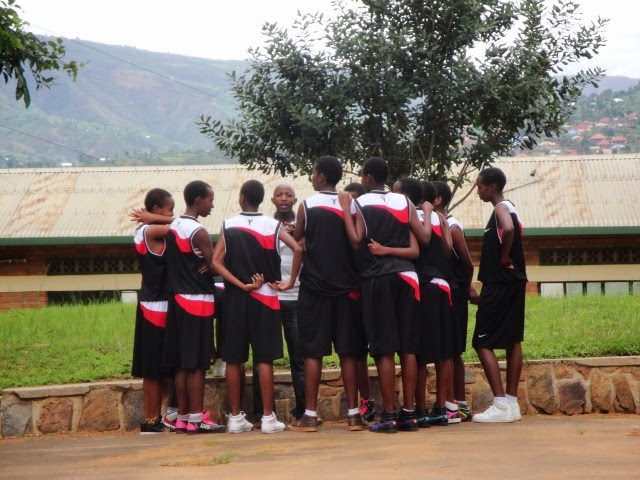
Playing Basketball in Maranyundo


Ready to play!
Basketball is HUGE in Rwanda.  It is undoubtedly the most popular sport among the girls at Maranyundo. Every evening after classes end at 4:30 the students get free time until 6:00 for sport and most of them head to the basketball court.
I think it would be extremely challenging to dribble on the Fawe School court, but the girls didn’t mention it
There is a three week holiday every April and the week before the break begins the students are done with exams and have little academic work left to do for the rest of the term.  Rwanda has such a young population that the government dictates staggered start and end dates for schools in each province so the all traffic is not at a gridlock as students travel to and from school.

Coaching
Because the students had few obligations, the secretary of Maranyundo (and my roommate) called up a friend from Fawe Girls School just outside the capital and arranged for a friendly basketball game between the two schools.  

  
The school has a team but there is no formal season or schedule, with all games being coordinated through informal contact such as this.  


So the last Tuesday of the term, our team was excitedly heading to Fawe Girls School to play the game.


The final score was 13-12.  The girls from both schools knew each other and were very excited to see their friends.  

 After the game they got about an hour to socialize and the coaches from both schools agreed the next game would be at Maranyundo.


On our way back to school we stopped at a little shop for some food and the girls tumbled out to buy cookies and chocolate to their heart’s content. They were ecstatic.

Thursday, May 8, 2014

Food #3 Zanzibar (Stone Town)

At first I wasn’t going to blog about my holiday in Zanzibar because I didn’t think it really fit with the reflective and analytical nature I attempt.

It was mostly just a pretty, touristy beach vacation, with turquoise waters, white sandy beaches, giant tortoises, dolphins and snorkeling to see coral and fish.

During my week in Zanzibar, I spent four nights in Stone Town, the capital, and two at Kendwa Beach. Kendwa is exactly what you would picture if you thought of a typical beach paradise.

It was very relaxing, however the beach seemed so isolated and I didn’t feel like I was in Zanzibar.  The area outside of the resorts are very rural and someone living on the island would never think of Kendwa when talking about home.  
Stone Town, on the other hand, had such…culture.  Over the centuries the island has hosted explorers from around the world leaving a mix of European, Arab, and Asian influences. I relished observing the graceful conventions of Islam seen through the social habits, relaxed routine, and beautiful, traditional garb.


The city slept late and came more alive at night, augmented by the numerous public spaces where there were nightly food festivals, games of soccer, young men working out and old men playing checkers.

The cheap nightly food festival in the central gardens is the most memorable part of the trip. The Zanzibarian pallet is huge and varied from the influences of all the groups that had ruled at one point or another (although I’m still not sure exactly what is produced for tourists, considering their large presence on the island). It was a nice change from the Rwandan choices of eggplant or cabbage each night.  Also, Rwanda has a strict taboo about eating in public and culture does not center around food at all. Even restaurants area fairly new phenomenon in the country. In fact, many of the events that would center around food elsewhere, such as weddings, are instead replaced by dancing here.  So being in an environment that appreciates food for its own sake was exotic.  The last, and possibly most important, reason I loved the gardens were because everyone came together to socialize.  Zanzibarians, tourists, families, young and old, it did not matter. I had several interesting conversations with English speaking locals and by the last night I knew quite a few people and my newfound friends had a prepared list of questions for me about English words or American customs.  Comparing to Rwanda again, I rarely talk to “strangers” because of the language differences, the fact that I’m in a relatively rural area and people are much more reserved, possibly because it is a police state.  So, let me share unique Zanzibar foods!

Firstly, if you ever get a chance to fly Rwandair, take that!  The service was impeccable, the airplane was very clean, only half full and this is the “snack” I got during the two hour flight, with a choice of chicken, beef or vegetarian. Beats the possibility of peanuts.  They also came by twice with drinks, including the option of complementary wine. I have never had such a pleasant flight experience.

Falafel wrap (best falafel I have had in a very long time) with roasted vegetable couscous.  Both had a vinaigrette sauce.

Closer to traditional Zanzibar food. Plate is rice with masala and potato. Upper bowl is a fish sauce, very spicy and flavorful.  Lower bowl is a coconut vegetable sauce, with a pleasant coconut flavor.

All the locals were eating this at the garden so I had to try it too.  It was not quite what I expected.  There were several toppin options an I took them all: boiled egg, two types of fried dough balls, coconut, and something green.  The broth was potatos and other vegetables with a vinegar-y flavor, no meaty broth flavor at all.  The hefty bowl was provided but expected back after I was done on the honor system.

A typical gardens food stand.  This is all prepared ahead of time, but it is a mystery how long it sits out, although they will gladly warm it up on the grill for you.  I didn’t get sick from it, so there’s that. 

 Seafood is huge in Zanzibar since it is surrounded by the ocean.

A marvel known as Zanzibar pizza!  This is the freshest you can get.  You choose you filling, either chicken, beef, veggies, tomatoes or the more expensive prawn option, they flatten out some dough, add an egg, cover it with more dough and fry it up in margarine.

Salad and chili sauce.  You can also get dessert pizzas with Nutella and peanut butter and covered with chocolate ice cream sauce.  I went to the same stand every time and noticed the filling getting more generous every time I came.  This was the first night’s serving.

Thursday, May 1, 2014

Zanzibar Doors

After spending a week in Uganda and another at home, it was time to head off to Zanzibar for the last leg of school break!  I must admit I had never thought I’d make it to Zanzibar (or Rwanda, for that matter) but it was a very restful and interesting trip.  Zanzibar has been christened a UNESCO World Heritage Site because so many cultures have come together to influence it, making Stone Town, it’s capital, a fascinating place just to walk around.  One of the more intriguing aspects to me were the Zanzibar doors.  These doors are a product of Swahili culture, which is better described as a bunch of other cultures mashed together.
One of the most fascinating architectural aspects of Stone Town are the numerous carved doors present on building ranging from the fanciest hotels to the most humble alleys.  These doors are a visible representation of the intercultural influences. According to THIS website:

The Arab influence is seen in the older doors; they are square, like the houses, and feature geometric designs. The “newer” doors, dating primarily to the late 19th century, reflect Indian influence and have arched tops and floral designs. Commonly seen elements are passages from the Quran, fish (representing the wish for many children), date trees (representing abundance) and lotus flowers (signifying regeneration).  It is interesting – and a bit terrifying – to note the large brass spikes on a great many doors, most likely a modification of a tradition from India where doors were spiked as a defense against elephants in war.

I found myself fascinated by them, not because of the carvings themselves (although they were remarkable) but because of the varying stages of preservation.  Take a look (and forgive my hasty picture taking skills, they aren't always so straight).
So much detail!

From far out

Square door

Arched door


Arabic writing at the top. And the studs are especially visible

The doors are still used today

...but are they also abused today?


Modern graffiti

decay


Entrance to the Hindu Temple!

Notice the lock chain on the ground


That ceiling is looking rough, but the door is still in relatively good shape

interesting lock, and bills posted on the door
paint over the original facade
more paint


Fancy hotel! Not sure if this is an original door or recreation though